Clear steps. Informed comparisons.

When to Refinance Your Home Loan

Refinancing may be worth considering when the full benefit of a new loan exceeds the cost of changing and the loan still fits your circumstances. There is no universal rate drop or waiting period that makes switching worthwhile for everyone.

Wooden hourglass against a pale brick wall
Practical guide
4 clear steps

How to check whether the timing of a refinance fits your plans

Measure the benefit you can actually compare

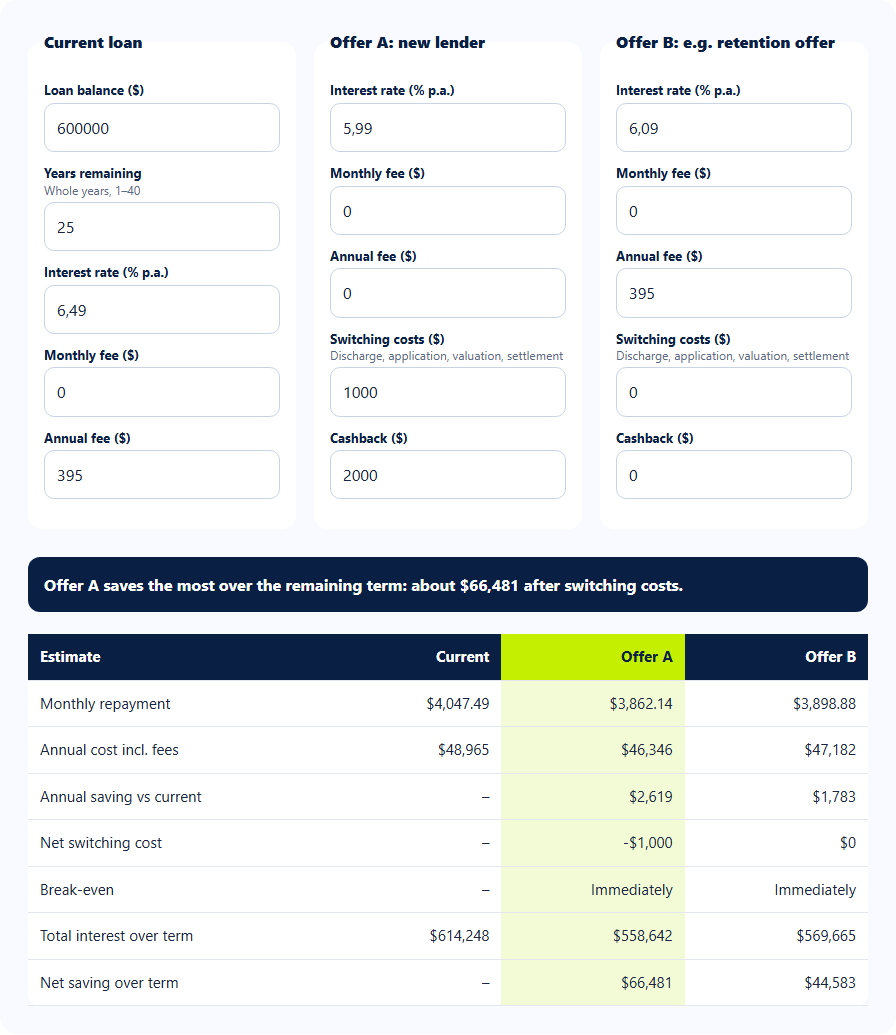
Gather a written offer and compare it with your current loan using the free refinance calculator. Use the same remaining term initially, and include monthly and annual account fees. A lower rate can be offset by larger fees or extra borrowing.

Write down any non-price reason for the change, such as a different repayment structure or account feature. The tool cannot value every feature for you. Keep a separate note of benefits you need to confirm with the lender.

Compare break-even with your holding period

Use the break-even calculator with all switching costs, any eligible cashback and monthly savings after ongoing fees. Compare its estimated recovery period with how long you expect to keep the new loan.

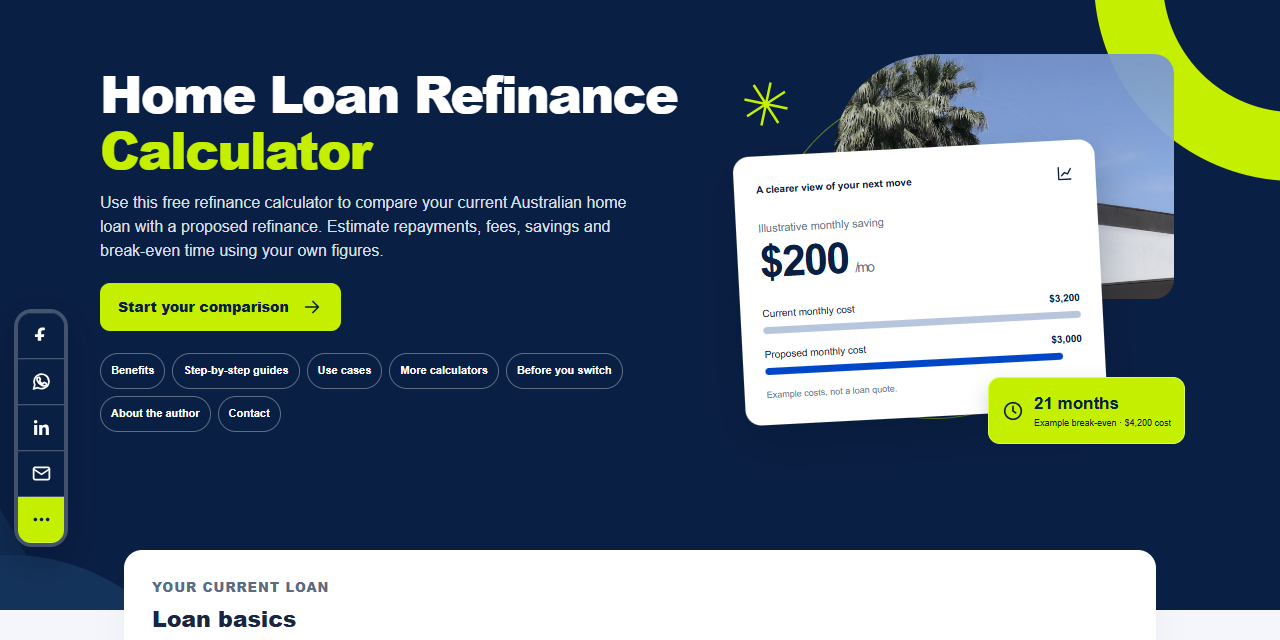
In the illustrative screenshot, $4,200 of costs and $200 monthly saving produce a 21-month break-even. At 18 months, the simplified cash-flow position is $600 behind; at 36 months it is $3,000 ahead. These are constant-input examples, not a forecast of rates, loan balances or your outcome.
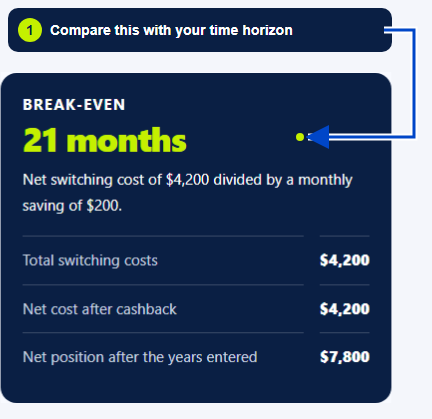
How to compare refinance break-even months with the time you expect to keep a loan
Illustrative calculator inputs. Follow the labelled arrow; replace example figures with your own quotes. Open full-size image (opens in a new tab).

Check the term and features before deciding

A fresh 30-year term may reduce a repayment while extending the debt. Request schedules for the proposed term and compare total interest, not only the first repayment. The main calculator uses one remaining term for both loans; it cannot show different terms in a single comparison.

List the offset, redraw and repayment flexibility you currently use. Confirm how the new product treats them and include their fees. If your fixed term is ending or you may leave it early, use the fixed-rate refinance guide before relying on a switching estimate.

Compare switching with a retention offer

Ask your current lender for a revised rate or fee arrangement and record the terms in writing. Use the two-offer comparison calculator to compare that option with the external quote.

If costs will not be recovered during your expected holding period, the purely financial case needs another look. If you still want to change for a particular feature, identify its value and cost explicitly. Use the checklist to keep the missing facts visible before applying.

Reasons to pause and check the numbers

  • You expect to sell or change loans again before recovering the switching cost.
  • The saving depends on cashback whose conditions are not confirmed.
  • The new repayment is lower mainly because the term is longer.
  • A quoted break cost is missing or no longer current.
  • The new product removes a feature you use, or your circumstances have changed since the quote.

A zero or negative monthly saving means there is no positive cost-recovery period in the simple break-even formula. It is a signal to revisit the inputs and reasons for changing, not to assume a future rate reduction will solve the difference.

Sources and calculator limits

Sources checked on 28 October 2026. Examples use fixed inputs; actual fees, rates, valuations and approval rules can differ. Read the calculator assumptions and limitations. For questions about the site, contact us. About Sana Hosseni and the calculators.

Continue exploring

Where will your next move take you?

Choose the calculator or guide that helps you understand your next refinance decision. Browse all calculators or explore the guides.