The Australian home loan guide library

Home loan refinance
guides.

Practical home loan refinance guides. Learn how to compare repayments, costs and equity, then use your own figures to explore the next step.

Miniature home and keys on a wooden table
Your home. Your next move.Clear guides for a considered comparison.

Read. Compare. Plan.

Home loan refinance guides

Start with the question that matches your situation. Every guide includes practical checks and links to the relevant tools.

Showing all 9 guides

Miniature home and house keys on a wooden table
Getting started

Understand the Australian refinancing process, collect loan statements, compare written offers and check the settlement details. Includes annotated calculator screenshots for your first comparison.

By Sana Hosseni

Modern white home with palm trees against a blue sky
Investment property

Compare an investment home loan using the correct lending purpose, balance and rate. Learn how extra borrowing affects repayments and where the calculator’s tax and interest-only limits apply.

By Sana Hosseni

Wooden hourglass against a pale brick wall
Costs & timing

Weigh the potential saving against switching costs, your break-even date and the time you expect to keep the loan. Include a retention offer from your current lender in the decision.

By Sana Hosseni

Blue pen resting on an open lined notebook
Getting started

Bring your balance, rate, remaining term, ongoing fees and proposed offer together. Use the interactive checklist to prepare documents, questions and figures before applying.

By Sana Hosseni

Calculator, paperwork and glasses arranged on a desk
Costs & timing

Compare leaving a fixed-rate loan early with waiting. Find out which lender quotes to request and how to include an actual break cost in your refinance estimate.

By Sana Hosseni
Calculator, paperwork and glasses arranged on a desk
Savings & equity

Calculate a monthly mortgage repayment, see how interest and principal change, and compare loan terms using a $500,000 worked example.

By Sana Hosseni
Miniature home and house keys on a wooden table
Savings & equity

Work through a $500,000 loan example to distinguish lower repayments from savings after fees. Compare your break-even date and see why a longer term can change the result.

By Sana Hosseni
Calculator, paperwork and glasses arranged on a desk
Costs & timing

Build a quote-based cost checklist, distinguish upfront and ongoing fees, and calculate how long savings take to cover the switch. Includes a worked cost-and-cashback example.

By Sana Hosseni
Modern white home with palm trees against a blue sky
Savings & equity

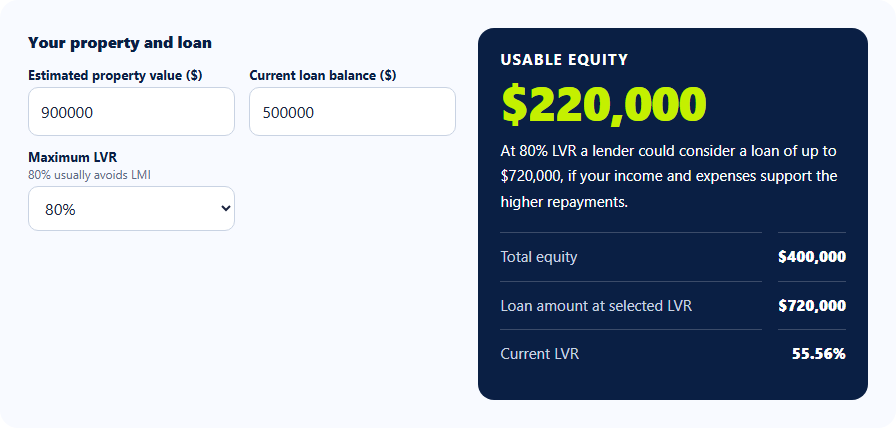
Separate total equity from potential extra borrowing. Work through an Australian property example, test a lower valuation and check the repayments on the proposed balance.

By Sana Hosseni

From statement to scenario

How to prepare your refinance calculation

A useful estimate starts with comparable inputs. These three steps help you avoid attributing a lower payment to a cheaper loan when the balance or repayment period has changed.

1

Gather the loan figures

Use your current statement for the outstanding balance, interest rate, ongoing fees and years remaining. Get the proposed lender’s written rate and fee quote. Use a separate proposed balance when borrowing extra.
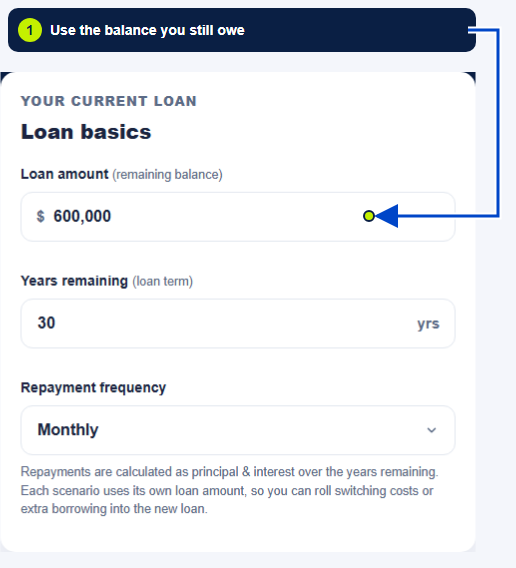
Show the calculator action
How to enter your outstanding Australian home loan balance in the refinance calculator
Follow the labelled arrow. Figures shown are examples; use your own statement and quotes.
2

Compare the same loan scenario

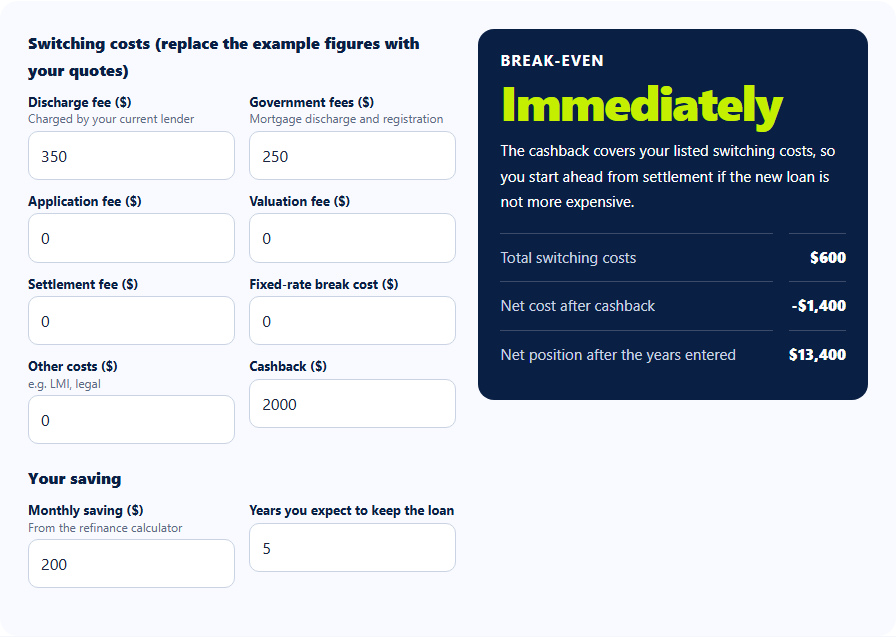
Enter both loans with the same remaining term and repayment frequency. Replace upfront cost estimates with quotes, and only include cashback you qualify for. Keep costs paid from cash distinct from amounts added to the loan.
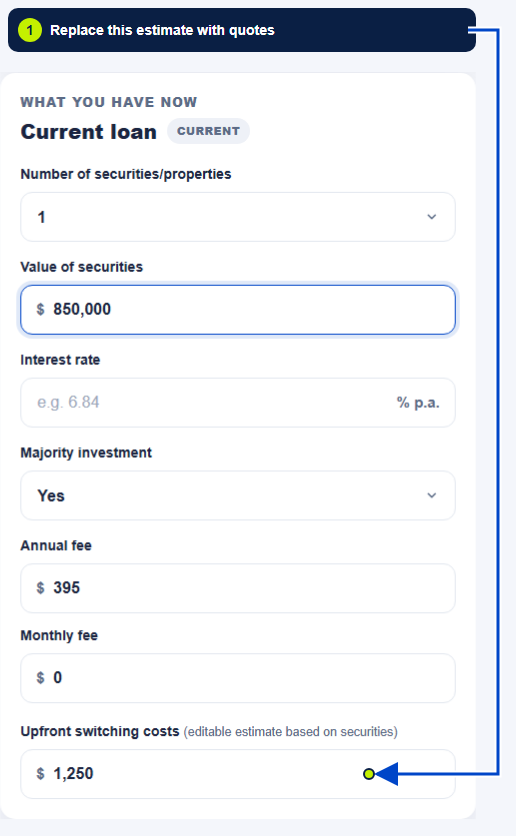
Show the calculator action
How to enter quoted switching costs in the Australian home loan refinance calculator
Follow the labelled arrow. Figures shown are examples; use your own statement and quotes.
3

Read the saving and break-even together

Check the ongoing saving, net switching cost and recovery time. Compare that time with your expected holding period, then review the loan features and assumptions before deciding whether to apply.
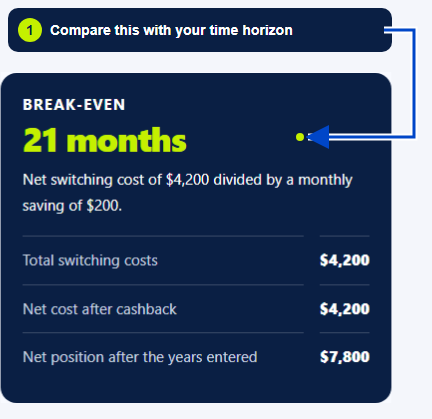
Show the calculator action
How to read the refinance break-even estimate and compare it with your holding period
Follow the labelled arrow. Figures shown are examples; use your own statement and quotes.

Worked example · AUD

When does a lower payment pay for the switch?

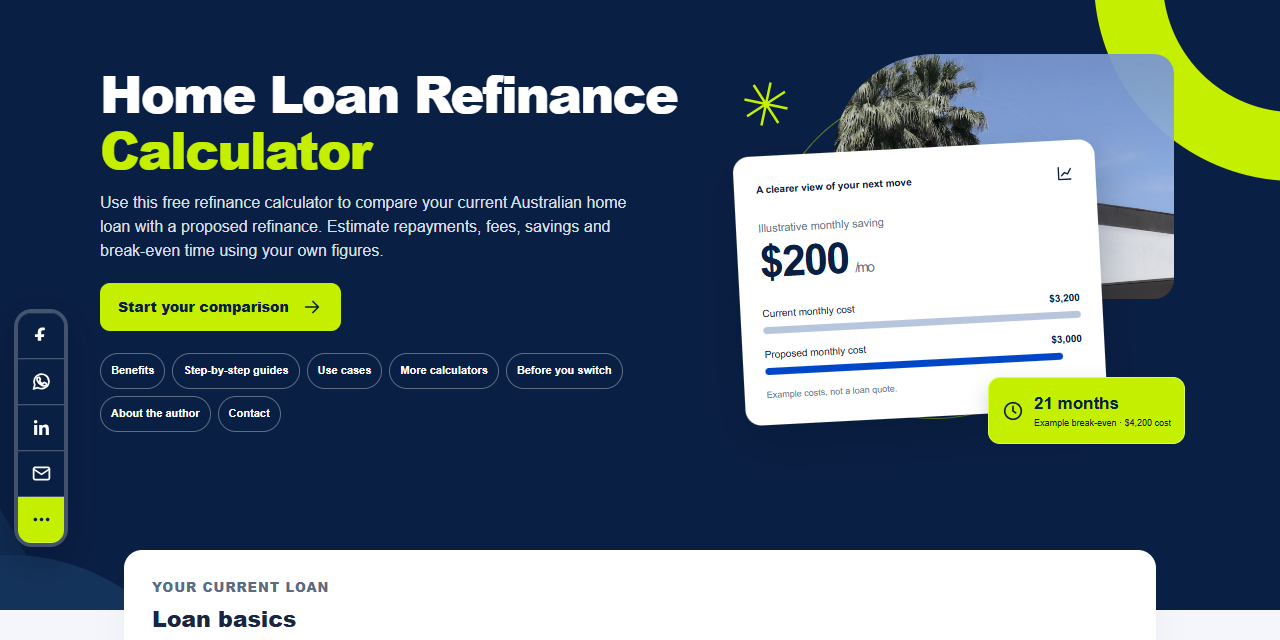
Suppose your current loan costs $3,200 a month in repayments and ongoing fees. A proposed loan costs $3,000 on the same balance and remaining term. That is a $200 monthly cash-flow saving. With $2,400 of net upfront costs, the simple recovery time is 12 months.

At six months, $1,200 of cumulative savings would still leave you $1,200 short of covering the switch. At 24 months, the savings would total $4,800, leaving $2,400 after the initial cost. This is a cash-flow illustration, not a comparison of outstanding loan balances.

Illustrative cost recovery
$2,400Net switching costs
÷
$200Monthly saving
=
12Months

Assumes a constant $200 saving, $2,400 paid upfront, no cashback and no additional costs. Rates and fees may change; this is not a forecast or offer.

Understand your estimate

Australian home loan refinancing questions

Direct answers to the decisions behind the figures: what to compare, what to include and what a calculator cannot tell you.

How do I calculate home loan repayments before refinancing?

Use the outstanding balance, quoted interest rate, remaining term and repayment frequency. For example, a $500,000 principal-and-interest loan at a constant 6% over 25 years has an estimated monthly repayment of $3,221.51 before fees. A longer term reduces each instalment but can increase total interest.

See the home loan repayment formula and worked example, then use the free refinance calculator to compare two loan scenarios including ongoing fees.

What does refinancing a home loan mean in Australia?

Refinancing means replacing your existing home loan with a new loan. You may switch lenders or change products with your current lender. The new loan pays out the old one; its rate, fees, features and repayment schedule then apply. A lower rate is one possible reason to switch, but it is not the whole comparison.

Start with the balance you still owe and the years remaining, rather than your original purchase price or original loan term. Our home loan refinancing guide explains the steps from comparison to settlement.

How do I calculate how much I could save by refinancing?

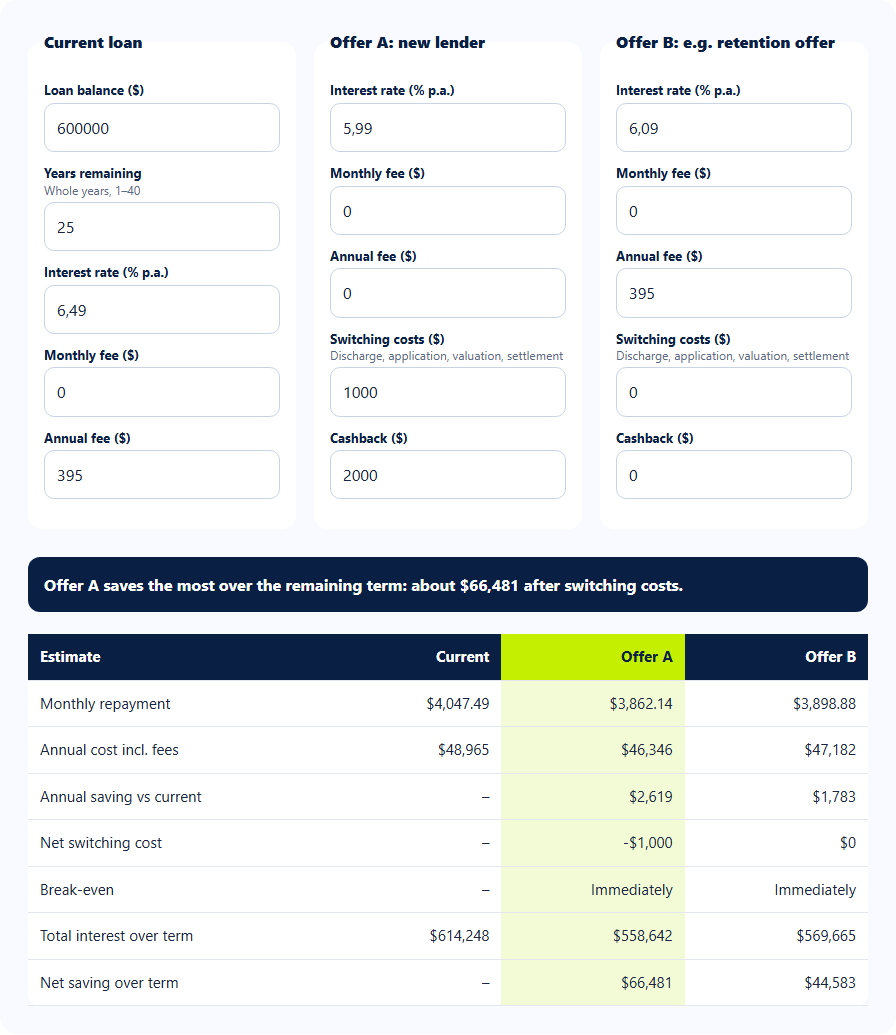
Compare scheduled repayments and ongoing fees for your current loan and the proposed loan over the same period. Subtract the proposed annual cost from the current annual cost to estimate annual cash-flow savings. Then account for the cost of switching. A repayment difference is not automatically an interest saving: a change in balance, loan term or repayment frequency can also change the payment.

The home loan refinance calculator uses principal-and-interest schedules and a common remaining term for both loans. Enter the proposed balance separately if you plan to borrow more. Its net saving over the term deducts net switching costs from the difference in total scheduled cash payments. Treat the result as a scenario, not a lender quote.

Worked examples and further checks: How much could I save by refinancing my home loan?

How do I calculate the break-even point on a refinance?

For a simple estimate, divide net upfront switching costs by the monthly saving after ongoing fees. For example, $2,400 of costs divided by a $200 monthly saving gives 12 months. If your saving is zero or negative and you have positive switching costs, those savings will not recover the cost. If costs are fully offset by a confirmed cashback, the upfront cost-recovery calculation may be immediate, but the ongoing loan still needs comparing.

Use the refinance break-even calculator with your actual costs and check the result against how long you expect to keep the loan. It is a constant-saving estimate: changing rates, balances, fees or repayments can move the break-even date.

Which Australian refinancing costs should I include?

Ask for itemised quotes for discharge, application, valuation, settlement and government mortgage registration charges. Add any fixed-rate break cost and any lenders mortgage insurance (LMI) quoted for the new loan. Check monthly, annual and offset fees separately so they enter the ongoing comparison, rather than being counted twice.

Costs vary by lender, product and state or territory; the calculator defaults are editable examples. Confirm whether fees will be paid from cash or added to the new loan, because capitalised fees can also attract interest. See NAB’s refinancing cost guide and use our refinancing checklist to collect written figures.

Worked examples and further checks: What does it cost to refinance a home loan in Australia?

Can a lower repayment still mean a more expensive home loan?

Yes. Extending the repayment period can lower each instalment while increasing the time interest is charged. Compare the same remaining term first, then request a separate repayment schedule for any longer term being offered. Also compare the balance you would owe when you expect to sell or refinance again.

Our main calculator keeps the remaining term the same for both loans; it does not model different terms side by side. Moneysmart recommends checking the length of the new loan. The guide to when to refinance helps put repayments, costs and your likely holding period together.

How do I calculate LVR and usable equity before refinancing?

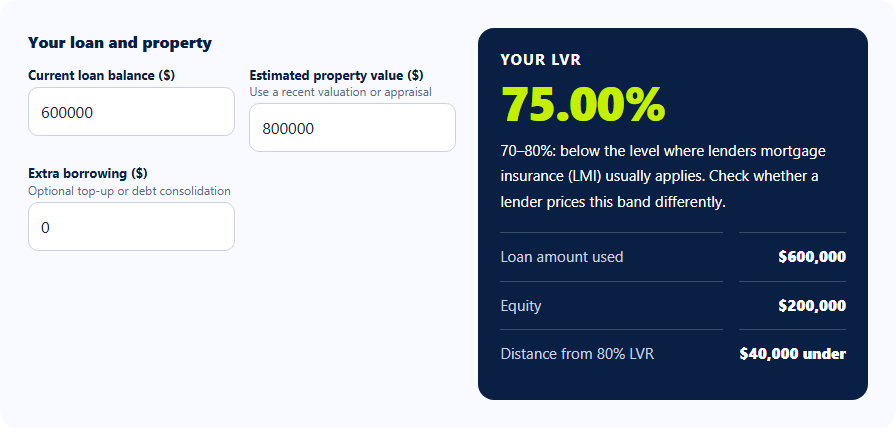
Loan-to-value ratio (LVR) is the loan amount divided by the property value, multiplied by 100. A $600,000 loan against an $800,000 home has an LVR of 75%. Total equity is $200,000, but that is different from usable equity. At an illustrative 80% borrowing limit, the calculation is $800,000 × 80% − $600,000 = $40,000 before costs.

The lender’s valuation and credit assessment determine what is actually available; 80% is an example, not a universal approval threshold. Accessing equity means taking on more debt secured against your home. Check the LVR calculator, usable equity calculator and CommBank’s equity explanation.

Worked examples and further checks: How much usable equity can I access when refinancing?

Can I refinance while my Australian home loan rate is fixed?

You may be able to, but leaving before the fixed period ends can trigger a break cost. Ask your current lender for a dated payout and break-cost quote, then compare switching now with waiting until the fixed period ends. Do not estimate a break cost from the advertised rate difference alone.

The fixed-rate refinancing guide shows where to enter the quote. Our calculator does not calculate a lender’s break cost or predict the rate available when your fixed period ends. NAB explains the costs and restrictions that can apply to fixed-rate loans.

Does the refinance calculation include my offset account?

Our repayment comparison does not model changing offset balances. Entering a smaller loan balance to imitate an offset can misrepresent the actual repayment schedule. Compare your loans using their actual balances, then ask each lender for a separate illustration using your expected offset balance and the product’s fees.

An offset reduces the balance charged interest, rather than paying down the loan principal itself. Its benefit depends on the money held in it, the rate and any extra product cost. If you refinance, confirm that the account is linked to the new loan. Moneysmart explains offset accounts and what to check when a loan changes.

Can I use these calculations for an investment property loan?

You can compare principal-and-interest investment home loan scenarios using the quoted investment rate, remaining term, balance and fees. If you plan to release equity, put the larger amount in the proposed-loan balance and compare the extra repayment as well as the rate.

The tools do not calculate rental returns, income tax, deductibility or an interest-only repayment period. A repayment saving is not an after-tax investment return. Read the investment property refinancing guide and confirm the loan structure with your lender and any tax implications with your tax adviser.

How do I compare a refinance offer with staying at my current bank?

Ask your current lender for a written retention offer, then compare it with the external offer using the same balance, remaining term and repayment frequency. Include ongoing fees, any product-change fee for staying, and the full switching costs for leaving. Check offset access, redraw rules and extra repayment restrictions alongside the numbers.

A cashback is a one-off benefit, not a recurring monthly saving. Only enter it if you meet the offer’s conditions, and review any payment timing or clawback terms. Use Compare two refinance offers to test both options against your current loan.

Put the guide into practice

Which calculation do you need?

Use the full comparison for repayments and savings, or choose a focused tool for one part of the decision. These estimates support your research; they do not assess borrowing capacity or approve a loan.

Continue exploring

Where will your next move take you?

Choose the calculator or guide that helps you understand your next refinance decision. Browse all calculators or explore the guides.

Sources, authorship and calculator limits

Written by for Australian homeowners and residential property investors. Sources checked on 29 October 2026. General information only; your lender’s written quote and loan contract determine the applicable rate, fees and terms.

Our main comparison models principal-and-interest repayments with constant rates and the same remaining term for both loans. It does not model daily offset balances, lender-specific break costs, tax outcomes, interest-only periods or a credit assessment. Read the calculator assumptions and limitations before using the results.