Clear steps. Informed comparisons.

How Much Could I Save by Refinancing My Home Loan?

Your potential refinance saving is the difference between the cost of keeping your current home loan and the cost of the proposed loan, after ongoing fees and switching costs. Compare the same balance and remaining term first; a lower advertised rate alone does not tell you the saving.

Wooden hourglass against a pale brick wall
Practical guide
4 clear steps

How to calculate your potential home loan refinance saving

Which figures do I need for a fair comparison?

Take the current balance, interest rate and years remaining from your latest loan information. Get a written rate and fee quote for the proposed loan. Keep the repayment frequency the same. If the current loan has 25 years remaining, use 25 years for the first comparison, even if the new lender initially quotes a 30-year term.
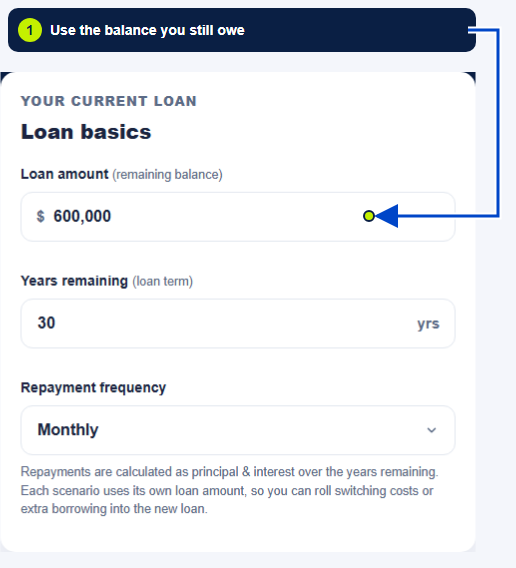
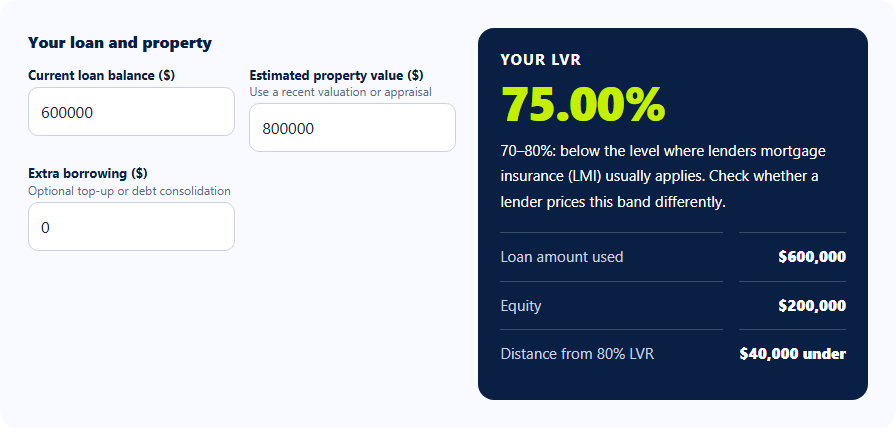
Enter those figures in the home loan refinance calculator. Use the actual balance being refinanced, not the property value or original purchase price. If you want to borrow extra, enter that amount in the proposed balance and label it as a separate borrowing scenario. Otherwise a repayment comparison can mix the benefit of a lower rate with the cost of a larger debt.

How to enter your current home loan balance and remaining term to calculate refinance savings
Illustrative calculator inputs. Follow the labelled arrow; replace example figures with your own quotes. Open full-size image (opens in a new tab).

How much difference could a 0.5 percentage-point rate reduction make?

Here is an illustrative Australian-dollar example: a $500,000 principal-and-interest loan, monthly repayments and 25 years remaining. At a constant 6.50% rate, the standard monthly repayment formula gives about $3,376.04. At 6.00%, it gives about $3,221.51. The repayment difference is approximately $154.53 per month before fees. These rates are example inputs, not current offers or a prediction.

Now suppose the current loan has no ongoing fees and the proposed loan has a $300 annual fee. Spreading that fee across the year reduces the monthly-equivalent cash-flow saving by $25, to about $129.53. The annual saving before switching costs is then approximately $1,554.35. Your actual cash flow may differ in the month an annual fee is charged. See how the monthly home loan repayment is calculated for the formula and principal-and-interest breakdown.

How long would it take to recover the switching costs?

Using the same example, assume $2,400 of switching costs paid upfront, no cashback and a constant monthly-equivalent saving of about $129.53. The simple break-even calculation is $2,400 รท $129.53, or about 18.5 months. You would need roughly 19 monthly saving periods to cover the initial outlay. Use unrounded figures when calculating, then round the result for presentation.
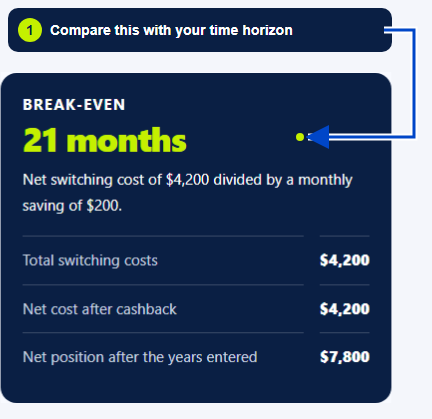
At 12 months, the simplified cumulative cash-flow position would still be about $845.65 behind after the switching cost. At 24 months, it would be about $708.69 ahead. These figures compare payments, not the outstanding loan balances at those dates. The costs and break-even calculator helps you test your own holding period, costs and savings.

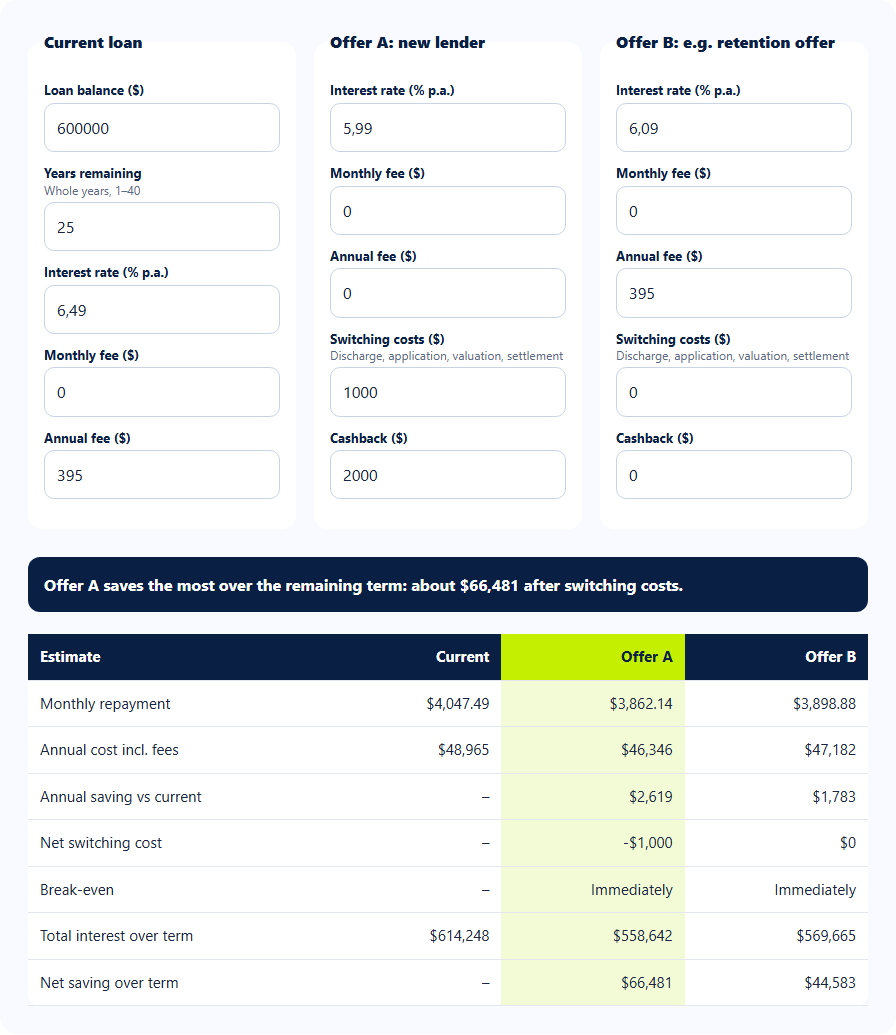
How to read refinance break-even months after including switching costs and ongoing fees
Illustrative calculator inputs. Follow the labelled arrow; replace example figures with your own quotes. Open full-size image (opens in a new tab).

What could make the apparent saving smaller?

Run a second comparison with less favourable assumptions: a smaller rate reduction, a higher quoted fee or no cashback. Do not count a promotional benefit before checking the conditions. Ask what happens after an introductory rate ends. Our main comparison assumes constant rates, so it does not predict a sequence of introductory and later rates.

Also ask your current lender for a retention offer. The two-offer calculator can help compare that option with moving lenders. Features such as offset access, redraw and extra repayment rules need separate review. A calculator cannot decide how much a feature is worth to your household or assess whether the lender will approve the application.

What else should I check before treating the result as a saving?

Illustrative $500,000 comparison: monthly repayments, 25 years, constant rates
MeasureCurrent loanProposed loan
Interest rate6.50%6.00%
Monthly principal and interest$3,376.04$3,221.51
Annual ongoing fee$0$300
Monthly-equivalent cost including fee$3,376.04$3,246.51

Does a lower repayment mean I pay less interest?

Not necessarily. In the example, extending the proposed 6.00% loan to 30 years reduces the scheduled monthly repayment to about $2,997.75, but adds five years of payments. Before fees, total scheduled interest is approximately $579,191 over 30 years, compared with $466,452 over 25 years at that same rate. The term change matters independently of the rate change. Our main calculator uses a common remaining term; ask for lender schedules to compare different terms.

Is my annual saving the same as money left over in the first year?

No. Annual saving in the tool compares recurring payments and fees. Upfront switching costs must still be recovered. Keep those two figures separate, especially if you may sell, refinance again or make a large repayment soon. The refinancing cost guide explains how to collect the inputs without counting a charge twice.

Can I keep paying the old repayment amount?

You can explore the calculatorโ€™s same-payment payoff scenario, but confirm that the proposed loan permits the extra payments and check any limits or fees. That scenario answers a different question: how quickly the new balance might be repaid at the specified payment, rather than how much monthly cash you could retain. Read the timing guide before choosing which outcome matters most to you.

What if my result is negative?

A negative saving means the proposed loan costs more under the inputs used. Check the balances, fee frequency and rate entries first. If the figures are correct, consider whether a feature or other reason justifies the added cost. Do not change assumptions merely to produce a positive result. Return to the Australian home loan guide library for the next question in your comparison.

Sources and calculator limits

Sources checked on 29 October 2026. Examples use fixed inputs; actual fees, rates, valuations and approval rules can differ. Read the calculator assumptions and limitations. For questions about the site, contact us. About Sana Hosseni and the calculators.

Continue exploring

Where will your next move take you?

Choose the calculator or guide that helps you understand your next refinance decision. Browse all calculators or explore the guides.