Refinance Calculator AU


How to calculate your home loan refinance costs and break-even
What will it cost to leave my current home loan?
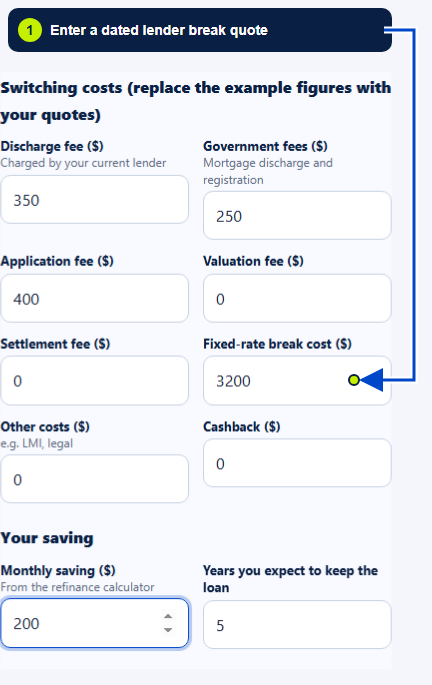
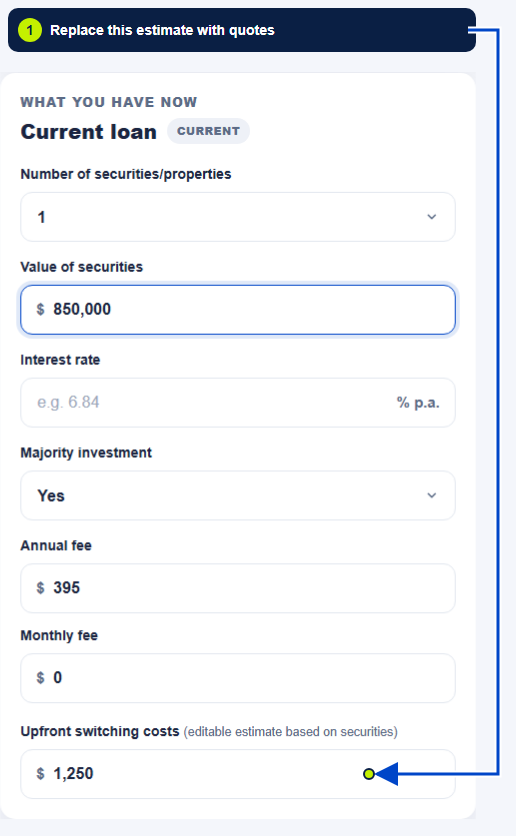
Request an itemised payout statement for your intended settlement date. Separate the outstanding loan principal from the fees: repaying the existing principal is not itself a switching fee. Ask whether discharge or administration charges apply, and whether the payout includes accrued interest or other amounts already covered elsewhere in your comparison.
Which costs belong to the new loan?
Ask the proposed lender for application, valuation and settlement charges, relevant government registration charges, and any LMI amount. Some items may be waived or included in another charge; record the final written quote rather than assuming every possible fee applies. Government charges depend on location and the transaction. Ask the lender or conveyancer which amounts apply to your circumstances.
How do the fees and cashback work together in an example?
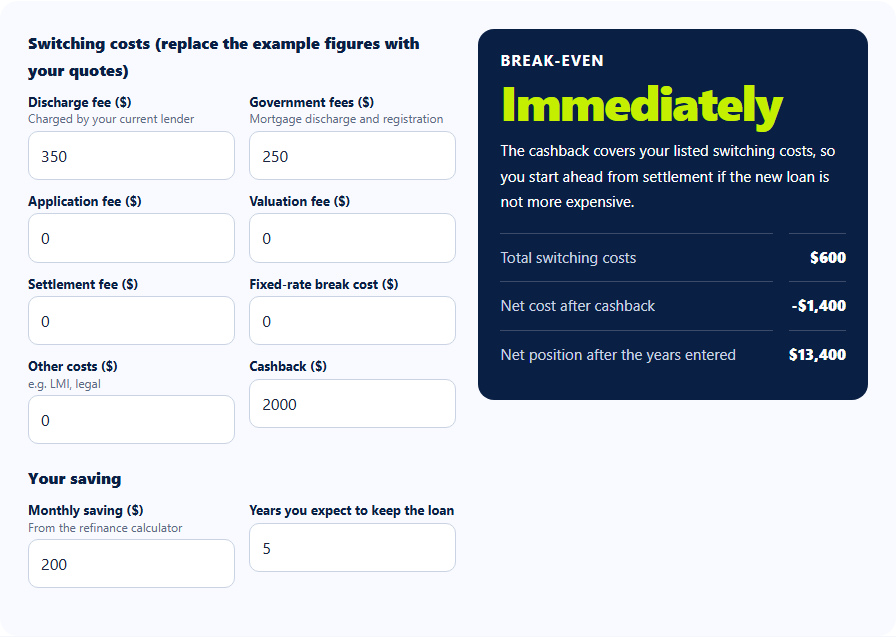
Consider a fictional quote with a $350 discharge charge, $500 application fee, $250 valuation charge and $700 combined settlement and government charges. These add to $1,800. They are arithmetic examples only, not typical fees or a schedule for any Australian lender or state. Assume no break cost and no LMI for this particular example.
Without cashback, a constant $150 monthly saving after ongoing fees would recover the $1,800 cost in 12 months. If a confirmed $600 cashback applies, the simplified net switching cost falls to $1,200 and the recovery period becomes eight months. If that cashback arrives later, you still need to fund the earlier payments; the simplified calculation does not model its payment date.
How do I decide whether the cost is worth paying?
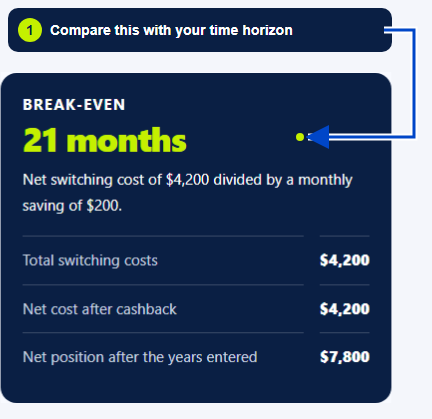
Compare the recovery period with your likely time in the new loan. With $1,200 of net cost and $150 of constant monthly savings, six months of savings total $900, leaving $300 unrecovered. At 24 months, savings total $3,600 and exceed the net upfront cost by $2,400. That is a simplified cash-flow comparison, not a forecast of variable rates or a valuation of the loan’s features.
Which costs are easy to overlook or count twice?
Can I add refinancing fees to the new home loan?
Ask the lender whether it will finance them. Adding costs to the balance means you can pay interest on those costs, and it changes the proposed LVR. Our simple costs tool does not automatically amortise capitalised fees. For a full comparison, use the lender’s proposed total balance and request a schedule that identifies financed costs; do not also treat the same amount as cash paid upfront. Keep the cost visible in your worksheet even if it is financed.
Will I have to pay lenders mortgage insurance again?
Does “no application fee” mean refinancing is free?
No. A waived application fee says nothing by itself about discharge, settlement, insurance, ongoing fees or a fixed-rate break cost. Put the offer’s written fee schedule beside the payout quote. Likewise, a cashback should be assessed together with the interest rate and recurring charges over your expected holding period.
What should I do before accepting the estimate?
Sources and calculator limits
Continue exploring
Where will your next move take you?
Calculators and practical guides
Compare your current loan with a new loan, including repayments, fees and payoff time.

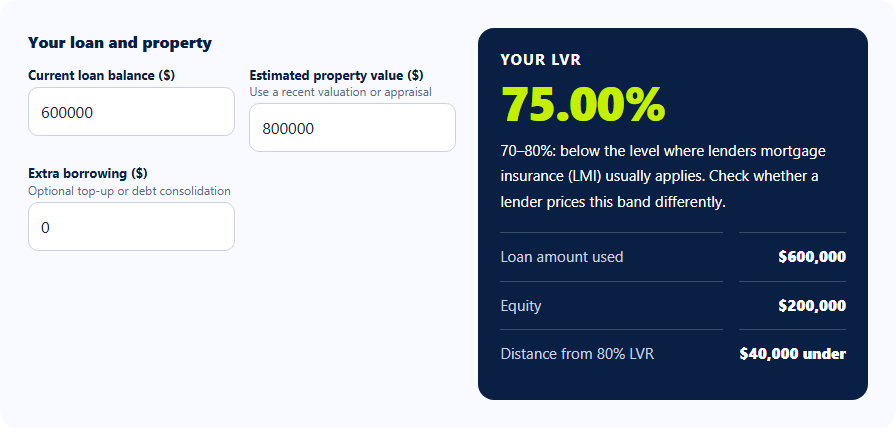
Work out your loan-to-value ratio, equity and distance from 80% LVR.

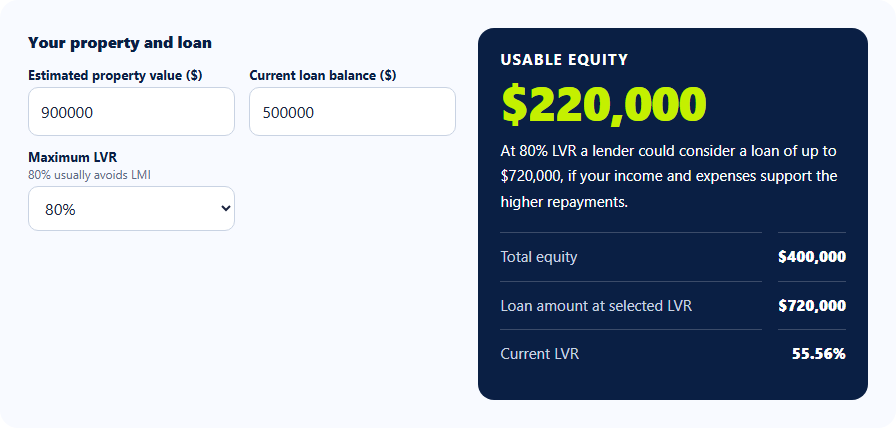
Estimate your usable equity and the loan amount at your chosen LVR.

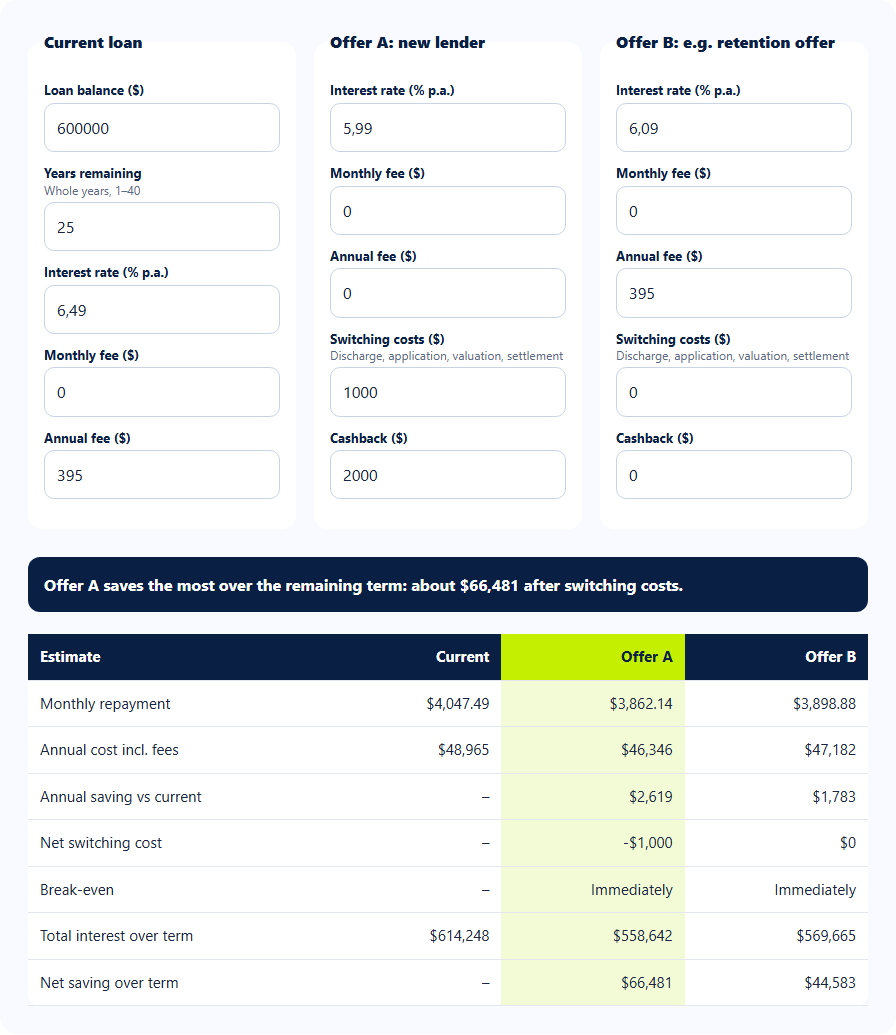
Compare two offers against your current loan, including fees and cashback.

Add up switching costs and estimate how long your savings take to cover them.