Refinance Calculator AU


How to calculate home loan repayments before refinancing
Which figures do I need to calculate my repayments?
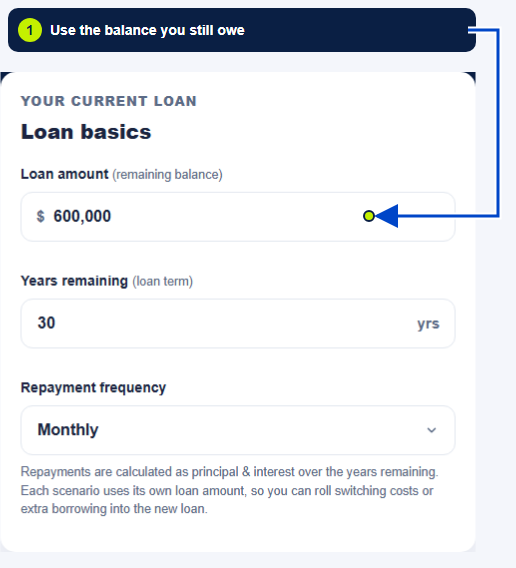
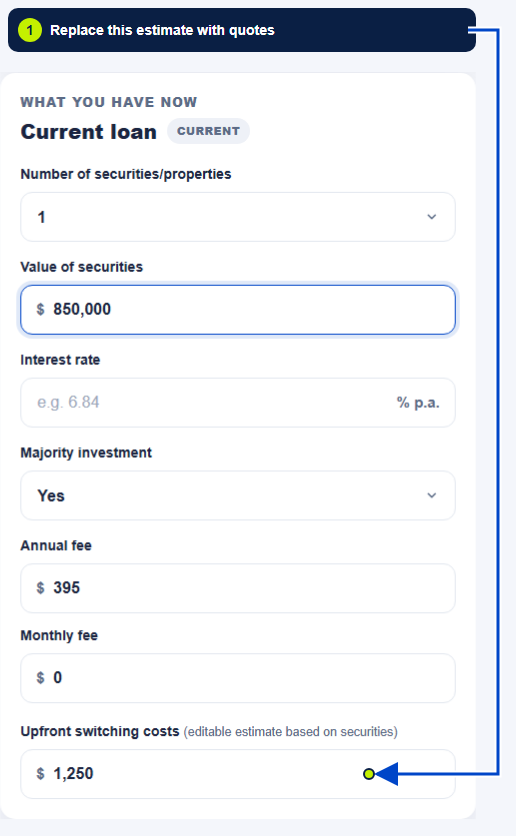
Find your current loan balance, actual interest rate and years remaining on your statement or in your lender’s account information. The balance is the amount still owed, not the original purchase price or the value of your home. If the original term was 30 years and five years have passed, check the actual remaining term rather than automatically entering another 30 years.
What is the monthly mortgage repayment formula?
For a constant-rate principal-and-interest loan, the monthly payment is M = P × r ÷ [1 − (1 + r)−n]. Here P is the outstanding principal, r is the annual rate expressed as a decimal divided by 12, and n is the number of monthly payments remaining. For 6%, r is 0.06 ÷ 12 = 0.005. For 25 years, n is 25 × 12 = 300. At a zero interest rate, use P ÷ n instead.
Putting P = $500,000, r = 0.005 and n = 300 into the formula gives $3,221.51 per month, rounded to cents. This is an illustrative mathematical schedule with constant rates, regular monthly periods and no fees. It is not a current lender offer. A lender’s contractual calculation, payment dates and rounding can produce a different figure, so use the repayment schedule in the actual quote when making a commitment.
How much of the payment is interest and how much reduces my balance?
In the first month of this simplified example, interest is $500,000 × 0.005 = $2,500. Subtracting that from the $3,221.51 payment leaves about $721.51 to reduce principal. The balance after that payment is approximately $499,278.49. In the next monthly period the same rate applies to a smaller balance, so the interest portion falls and the principal portion grows.
This process is called amortisation. Dividing $500,000 by 300 gives $1,666.67, but that is only a straight division of principal: it leaves out interest and is not the repayment at 6%. Similarly, calculating one month’s interest alone gives an interest-only amount, not the payment that clears the debt over 25 years. Our main tool models principal-and-interest loans.
How do I use the repayment when comparing a refinance?
Add recurring fees to understand the cost of keeping each loan. If this example also has a $10 monthly account fee and a $300 annual fee, the monthly-equivalent ongoing cost is $3,221.51 + $10 + $25 = $3,256.51. That equivalent spreads the annual fee across 12 months; the actual cash debit can be different in the month the annual fee is charged.
What changes my repayment estimate?
Does extending the loan term save me money?
In the example, moving from 25 to 30 years at 6% reduces the scheduled monthly payment by about $223.76. However, total scheduled interest rises by about $112,739 because repayments continue for five more years. The table uses unrounded monthly calculations for totals. A lower instalment can help cash flow while still increasing the full-term cost. Our refinance calculator uses one shared remaining term; request separate lender schedules if the terms differ.
Can I divide the monthly repayment by two to get a fortnightly payment?
Check the convention first. Paying half the monthly amount every fortnight means 26 half-payments, equivalent to 13 monthly payments per year. In this example that is about $1,610.75 each fortnight. It is an accelerated schedule, not the same annual cash outlay as 12 monthly payments. Our calculator labels that option separately. Standard weekly and fortnightly options use their own payment periods. Confirm the lender’s required payment and calendar rather than assuming every calculator uses the same method.
How do extra repayments or an offset affect the calculation?
Why does my bank’s repayment differ from this example?
Check that the balance, rate, remaining term, payment frequency and included fees match. Then check payment dates, the interest calculation convention, rounding and whether the loan contains an interest-only period. The example assumes regular monthly periods and a constant rate. Your lender’s schedule governs the actual payments. Keep a copy of the assumptions so the comparison can be repeated when a quote changes.
Which calculator should I use after checking repayments?
Sources and calculator limits
Continue exploring
Where will your next move take you?
Calculators and practical guides
Compare your current loan with a new loan, including repayments, fees and payoff time.

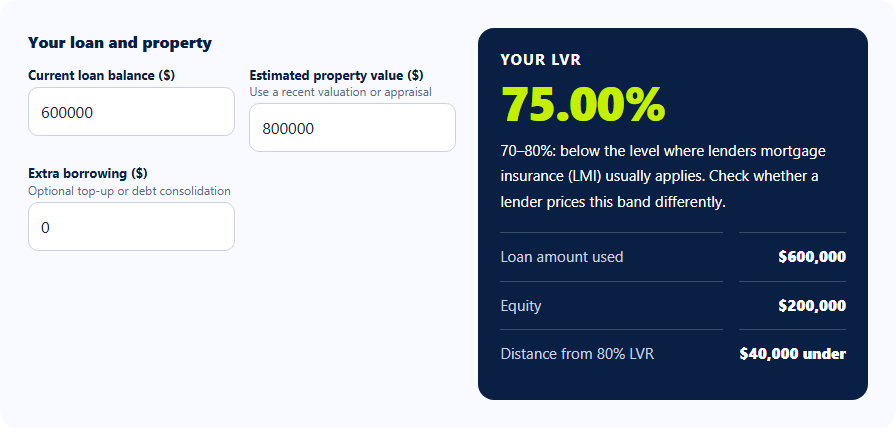
Work out your loan-to-value ratio, equity and distance from 80% LVR.

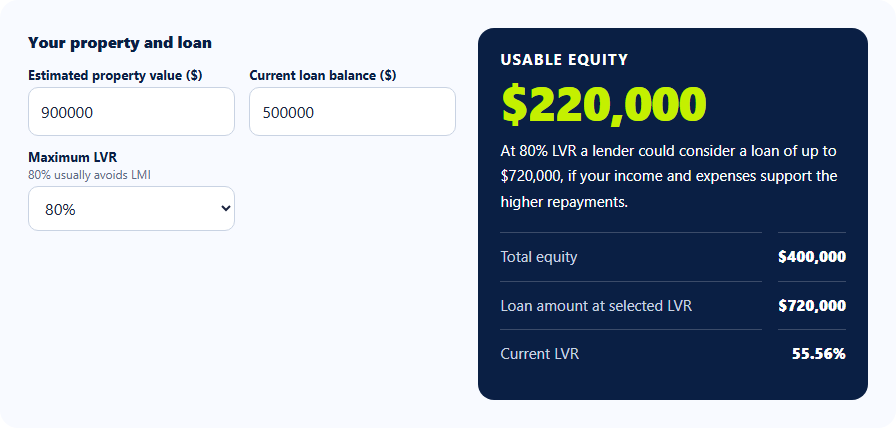
Estimate your usable equity and the loan amount at your chosen LVR.

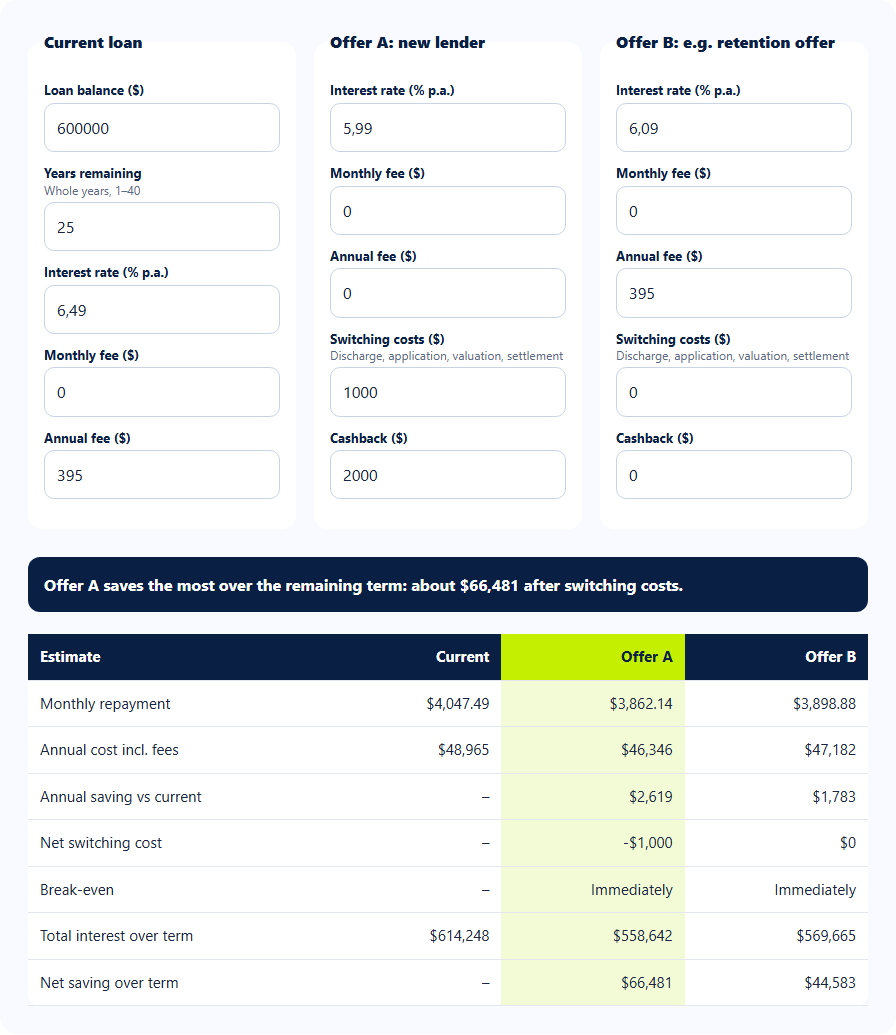
Compare two offers against your current loan, including fees and cashback.

Add up switching costs and estimate how long your savings take to cover them.