Refinance Calculator AU

Getting started
 By Sana Hosseni
Understand the Australian refinancing process, collect loan statements, compare written offers and check the settlement details. Includes annotated calculator screenshots for your first comparison.
By Sana HosseniThe Australian home loan guide library
Practical home loan refinance guides. Learn how to compare repayments, costs and equity, then use your own figures to explore the next step.
Read. Compare. Plan.
Start with the question that matches your situation. Every guide includes practical checks and links to the relevant tools.
Showing all 9 guides
Understand the Australian refinancing process, collect loan statements, compare written offers and check the settlement details. Includes annotated calculator screenshots for your first comparison.
By Sana Hosseni
Compare an investment home loan using the correct lending purpose, balance and rate. Learn how extra borrowing affects repayments and where the calculator’s tax and interest-only limits apply.
By Sana Hosseni
Weigh the potential saving against switching costs, your break-even date and the time you expect to keep the loan. Include a retention offer from your current lender in the decision.
By Sana Hosseni
Bring your balance, rate, remaining term, ongoing fees and proposed offer together. Use the interactive checklist to prepare documents, questions and figures before applying.
By Sana Hosseni
Compare leaving a fixed-rate loan early with waiting. Find out which lender quotes to request and how to include an actual break cost in your refinance estimate.
By Sana HosseniCalculate a monthly mortgage repayment, see how interest and principal change, and compare loan terms using a $500,000 worked example.
By Sana HosseniWork through a $500,000 loan example to distinguish lower repayments from savings after fees. Compare your break-even date and see why a longer term can change the result.
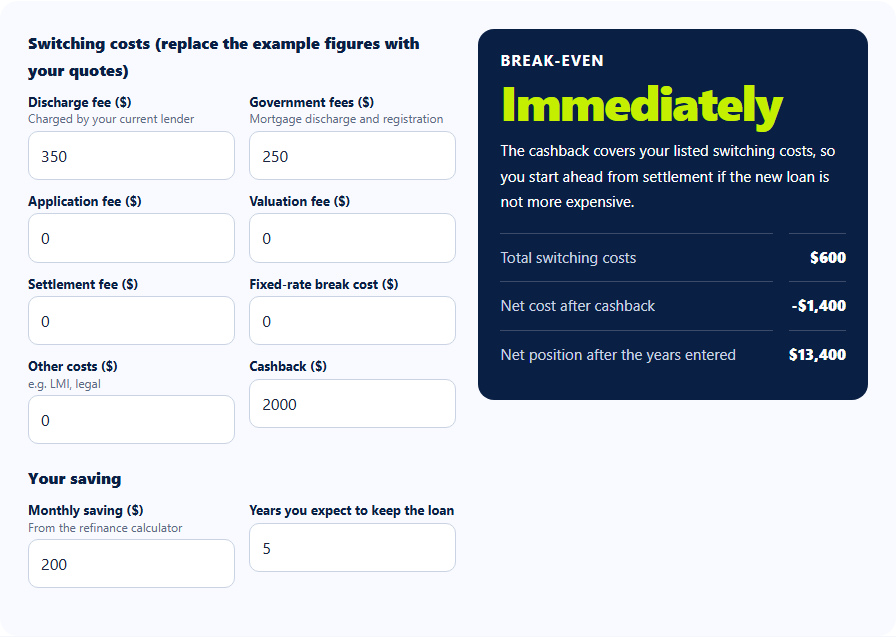
By Sana HosseniBuild a quote-based cost checklist, distinguish upfront and ongoing fees, and calculate how long savings take to cover the switch. Includes a worked cost-and-cashback example.
By Sana HosseniSeparate total equity from potential extra borrowing. Work through an Australian property example, test a lower valuation and check the repayments on the proposed balance.
By Sana HosseniFrom statement to scenario
A useful estimate starts with comparable inputs. These three steps help you avoid attributing a lower payment to a cheaper loan when the balance or repayment period has changed.
Use your current statement for the outstanding balance, interest rate, ongoing fees and years remaining. Get the proposed lender’s written rate and fee quote. Use a separate proposed balance when borrowing extra.
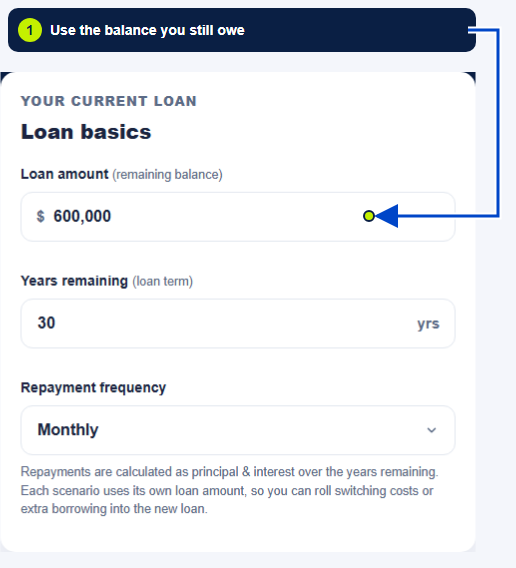
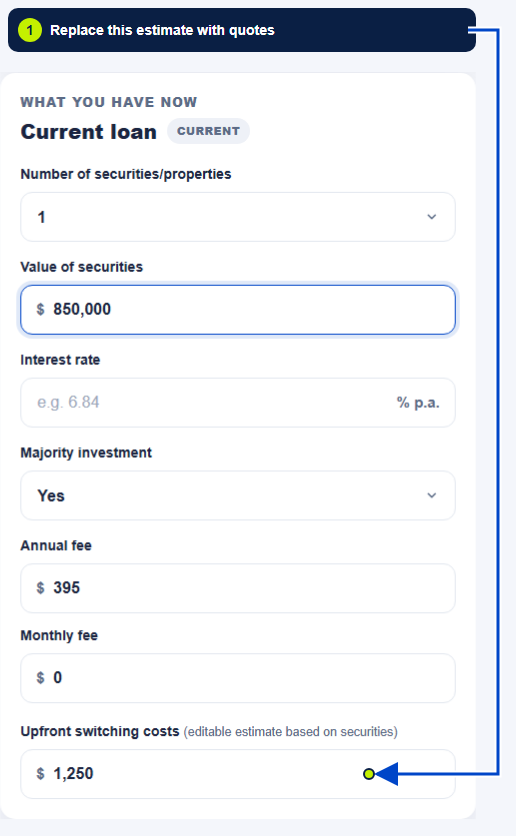
Enter both loans with the same remaining term and repayment frequency. Replace upfront cost estimates with quotes, and only include cashback you qualify for. Keep costs paid from cash distinct from amounts added to the loan.
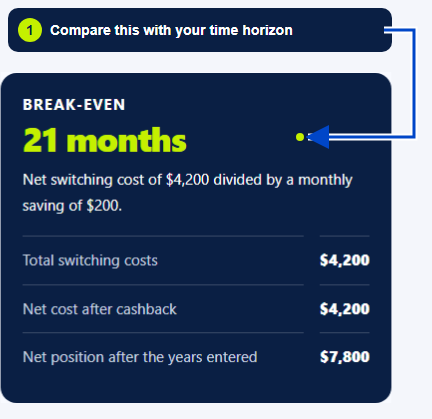
Check the ongoing saving, net switching cost and recovery time. Compare that time with your expected holding period, then review the loan features and assumptions before deciding whether to apply.
Worked example · AUD
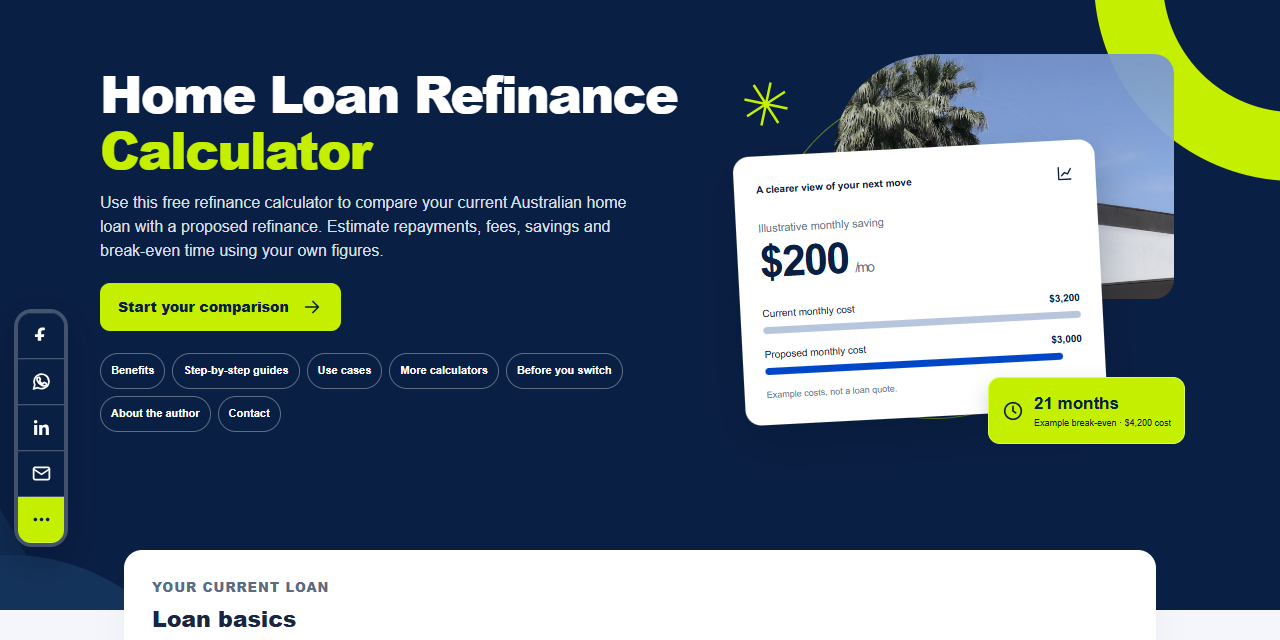
Suppose your current loan costs $3,200 a month in repayments and ongoing fees. A proposed loan costs $3,000 on the same balance and remaining term. That is a $200 monthly cash-flow saving. With $2,400 of net upfront costs, the simple recovery time is 12 months.
At six months, $1,200 of cumulative savings would still leave you $1,200 short of covering the switch. At 24 months, the savings would total $4,800, leaving $2,400 after the initial cost. This is a cash-flow illustration, not a comparison of outstanding loan balances.
Assumes a constant $200 saving, $2,400 paid upfront, no cashback and no additional costs. Rates and fees may change; this is not a forecast or offer.
Understand your estimate
Direct answers to the decisions behind the figures: what to compare, what to include and what a calculator cannot tell you.
Put the guide into practice
Use the full comparison for repayments and savings, or choose a focused tool for one part of the decision. These estimates support your research; they do not assess borrowing capacity or approve a loan.
Continue exploring
Compare your current loan with a new loan, including repayments, fees and payoff time.
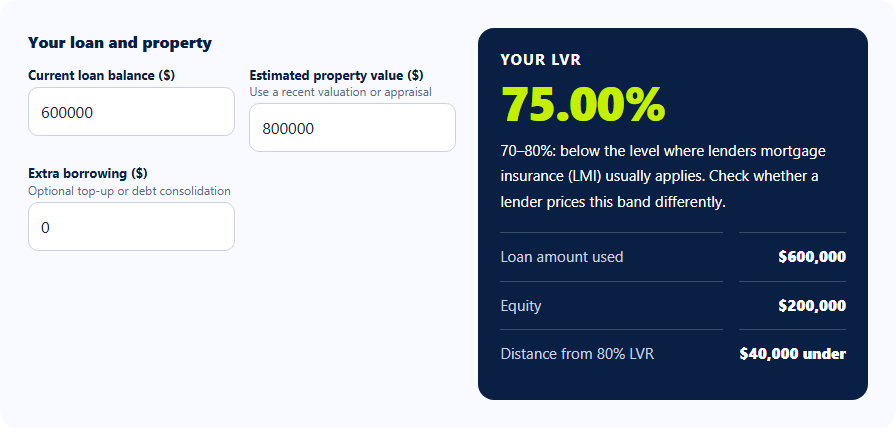
Work out your loan-to-value ratio, equity and distance from 80% LVR.
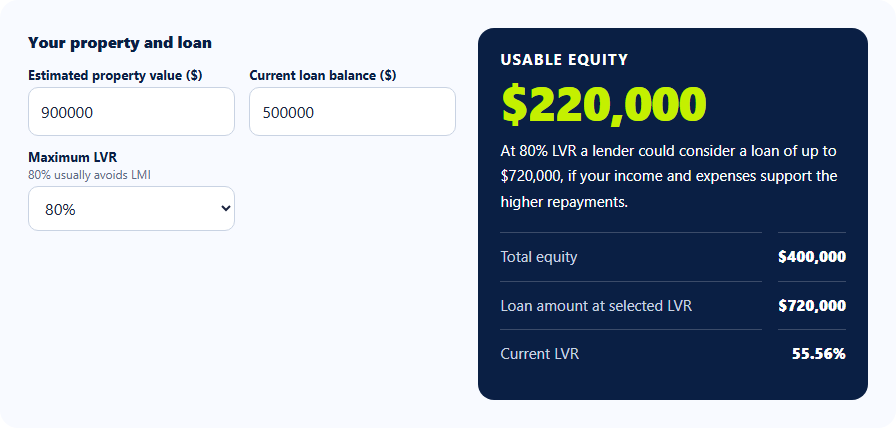
Estimate your usable equity and the loan amount at your chosen LVR.
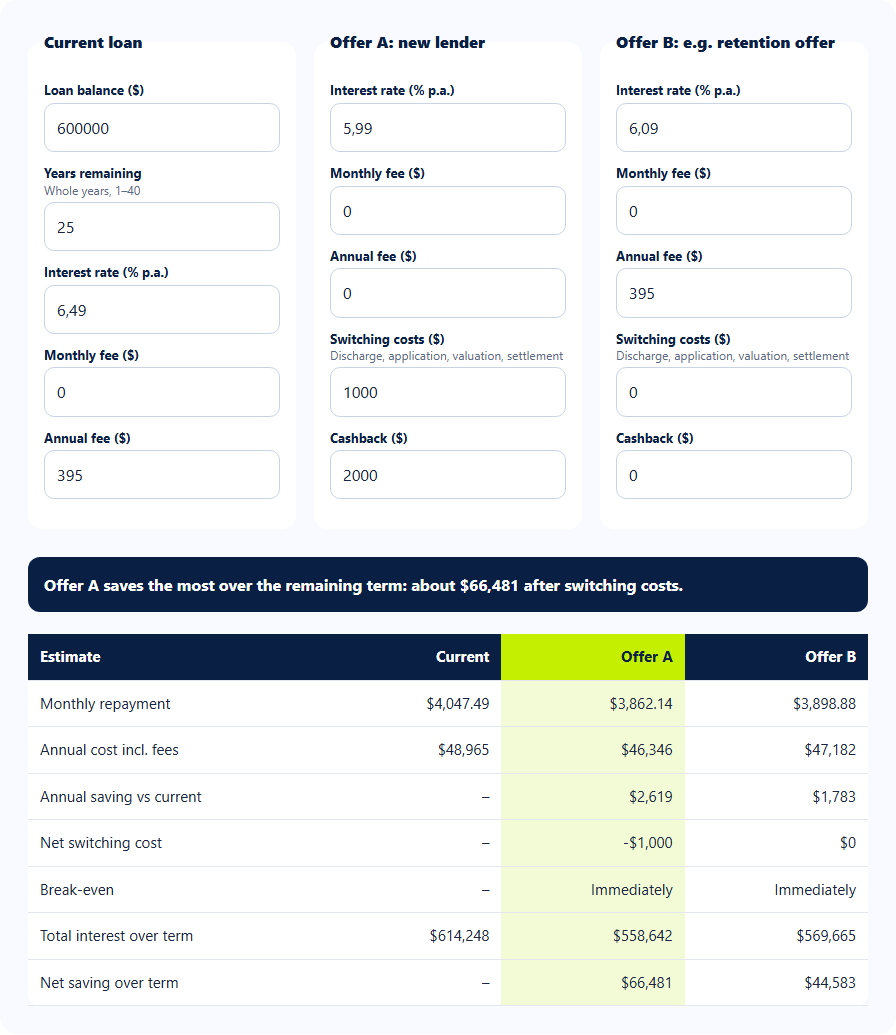
Compare two offers against your current loan, including fees and cashback.
Add up switching costs and estimate how long your savings take to cover them.