Refinance Calculator AU


How to estimate usable equity for a home loan refinance
What is the difference between equity and usable equity?
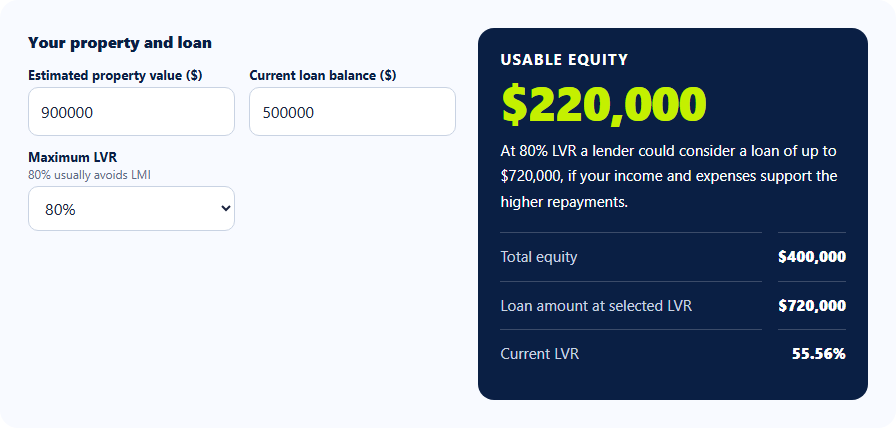
Total equity is the property value minus the outstanding debt secured against it. For a $900,000 home and a $500,000 loan, total equity is $400,000. An indicative usable equity calculation leaves room below a chosen lending limit. At an illustrative 80% LVR, the total-loan ceiling is $720,000, leaving $220,000 above the existing $500,000 balance before costs.
How do I calculate LVR if I want to borrow more?
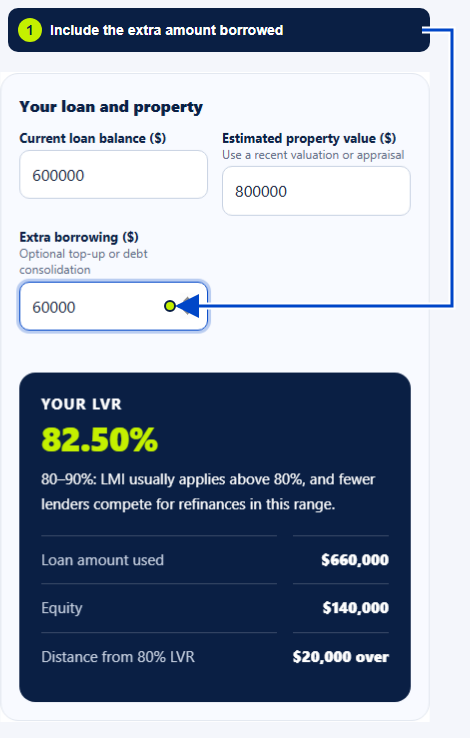
Divide the proposed total home loan by the property value, then multiply by 100. In the example, the existing $500,000 balance is 55.56% of $900,000. Adding $75,000 makes the proposed balance $575,000 and the LVR approximately 63.89%, before any financed costs. The amount released is only part of the new loan; the existing debt still has to be included.
What happens if the lender values my property lower?
At a $900,000 valuation, an 80% illustrative ceiling leaves $220,000 above a $500,000 loan. At $850,000, that room falls to $180,000. At $700,000, it falls to $60,000. The same outstanding debt produces a different equity result when the valuation changes. A hoped-for sale price or online estimate is not a substitute for the valuation the lender accepts.
Test a range of plausible values before committing to a project funded by extra borrowing. In the $900,000 example, financing $5,000 of costs would reduce the amount left below the same $720,000 ceiling from $220,000 to $215,000. This still does not establish how much cash the lender will release or how it will structure the borrowing.
Can I afford the repayments after accessing equity?
What does an equity estimate tell me—and what does it leave out?
Is usable equity money I already own in a bank account?
No. Equity is a value relationship. Releasing it through borrowing increases the debt secured against your property and creates a repayment obligation. A calculator output is not a withdrawal facility, a loan offer or a guarantee that the funds can be used for a particular purpose.
Can I refinance without releasing equity?
Does LVR below 80% guarantee approval or the best rate?
No. A ratio is not a credit assessment or a product recommendation. Property acceptability, income, other debts and lender rules still matter. Ask the lender which LVR calculation it uses and whether insurance or other charges apply. Our selected-limit estimate does not choose the most suitable limit for you.
What if the usable equity calculation is zero or negative?
At the selected limit, the model has no positive room for additional debt. For example, a $700,000 loan against an $800,000 property exceeds an 80% ceiling of $640,000 by $60,000. That does not mean all refinancing is impossible: it means that particular limit does not support a top-up under those inputs. Discuss the actual options with a lender rather than assuming approval at another limit.
What should I take to a lender or broker?
Sources and calculator limits
Continue exploring
Where will your next move take you?
Calculators and practical guides
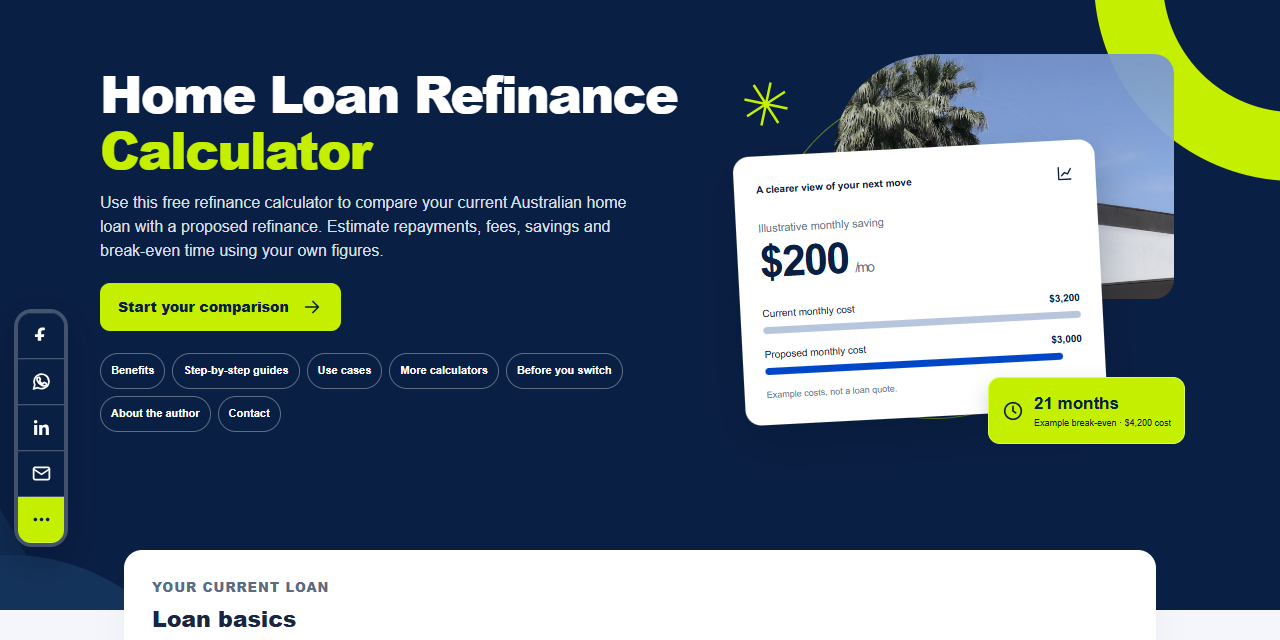
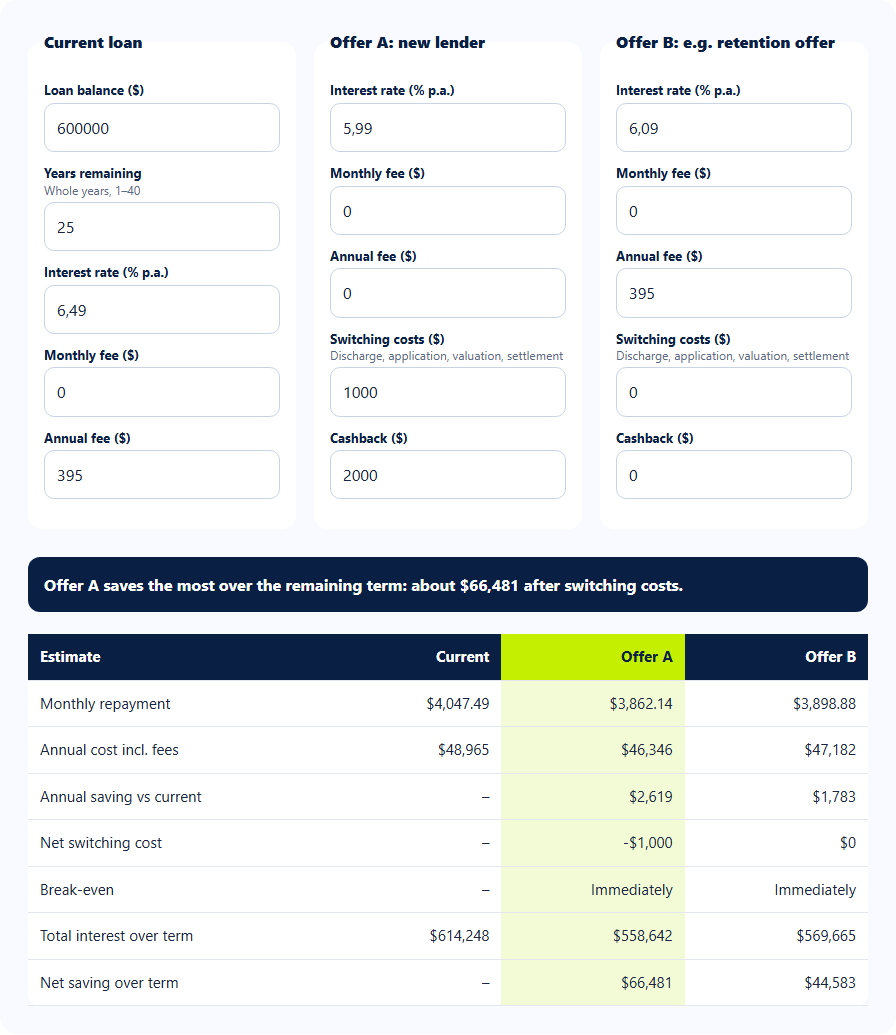
Compare your current loan with a new loan, including repayments, fees and payoff time.

Work out your loan-to-value ratio, equity and distance from 80% LVR.
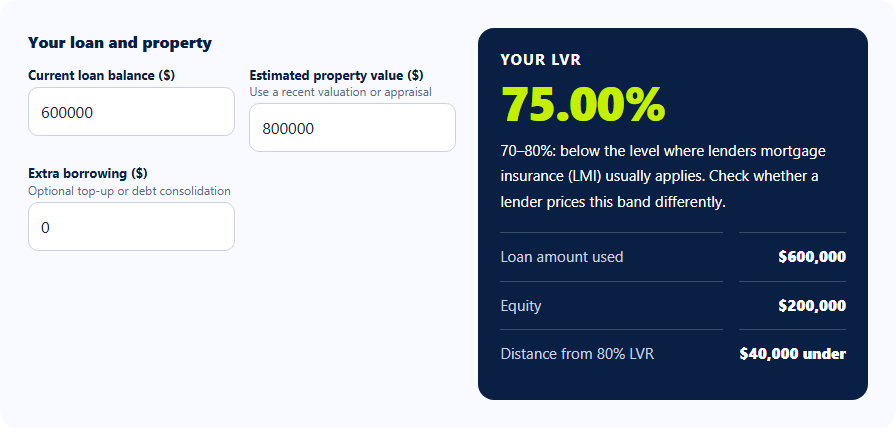
Estimate your usable equity and the loan amount at your chosen LVR.

Compare two offers against your current loan, including fees and cashback.

Add up switching costs and estimate how long your savings take to cover them.